Emergency Garage Door Repair Near Me: What Tampa Homeowners Should Do First
When your garage door fails, the first 20 minutes determine whether you’re looking at a simple repair or a cascading mess. Most emergency calls we get in Tampa start the same way: a homeowner yanked the door, forced the opener, or wedged something under a half-fallen panel. The right sequence is easy to learn and takes less time than the panic itself. If you need help right now, call (866) 253-5794 and we’ll talk you through it while a technician heads your way.
Step One: Stop Touching the Door and Assess What Actually Happened
The most dangerous part of a garage door emergency is the first instinct to fix it by hand. When a spring snaps, the door weighs between 130 and 400 pounds depending on its size and material. That weight is now sitting on whatever is left: the cables, the tracks, or nothing at all. Yanking the handle, pulling the emergency release, or shoving the door upward is how a $200 spring replacement becomes a bent track, a shattered panel, and a hospital visit.
Here’s the sequence we recommend for every Tampa homeowner, in order:
- Freeze. Don’t touch the door, the opener button, or anything attached to the system.
- Look at the door’s position. Is it fully closed, fully open, or stopped mid-cycle? Each position has a different risk profile.
- Look at the cables and springs. If you see a dangling cable or a spring with a visible gap in the middle, do not go near it.
- Disconnect the opener. Unplug the motor unit from the ceiling outlet so nobody activates it by mistake.
- Secure the area. Keep kids, pets, and cars away from the door entirely.
We’ve pulled doors out of garages in Carrollwood and Westchase where the homeowner kept pressing the opener button after a cable snapped, hoping the door would “reset itself.” The motor kept pulling against a bound rail until the shaft bent. That’s a $150 problem turned into a $700 one. You don’t fix a garage door by repeating the action that broke it.
What to Do When the Door Fails in Each Position
A door that fails while closing presents different risks than one that fails while opening. Here’s how to read what you’re seeing in a Tampa garage:
Door failed while closing (stopped mid-cycle or hit the ground wrong)
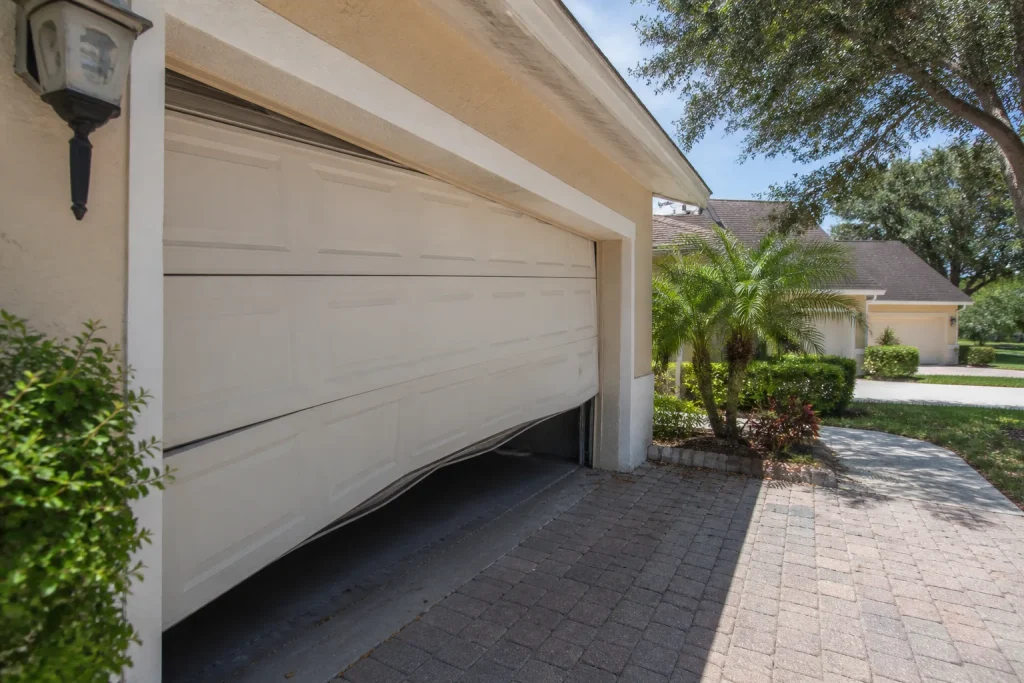
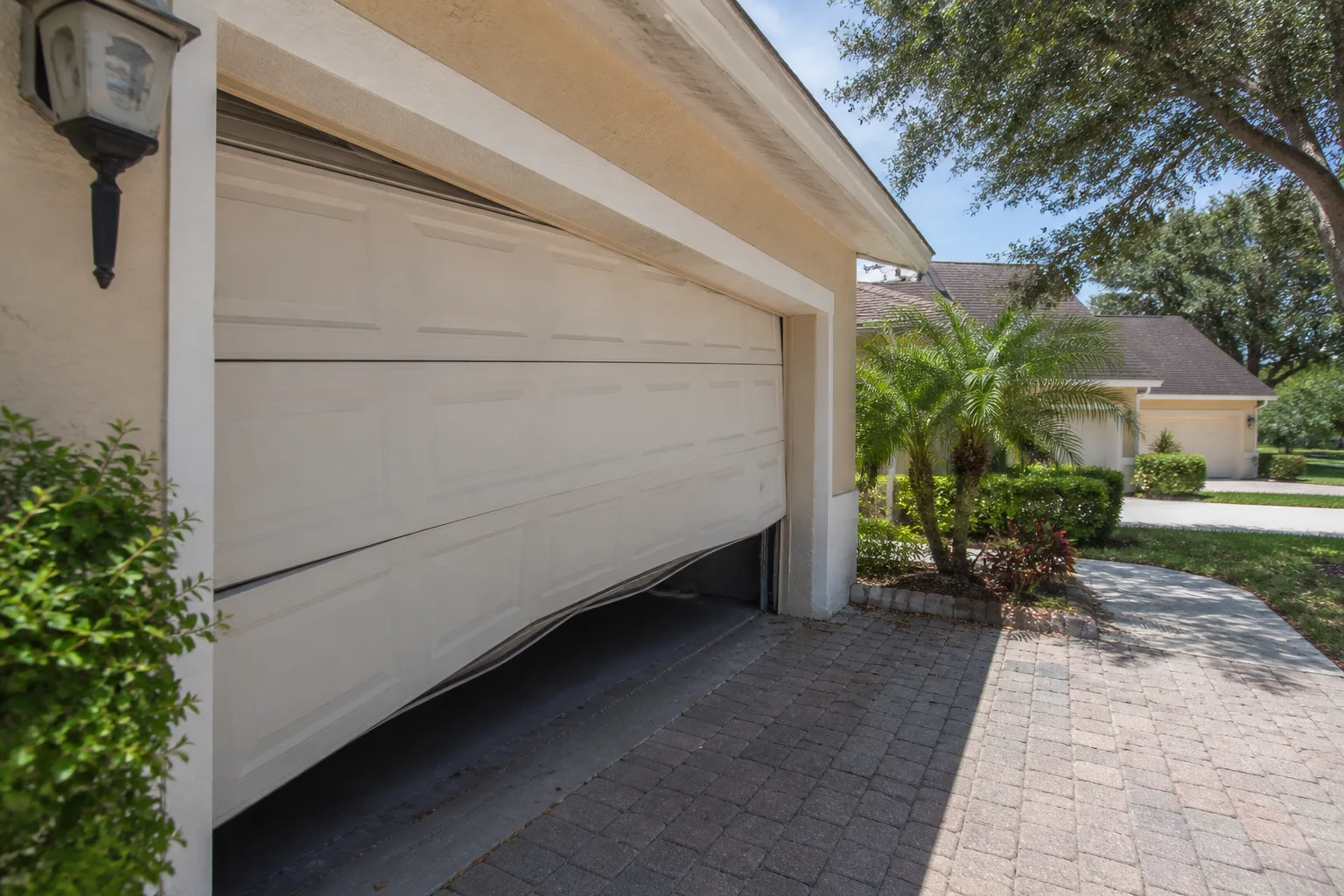
This is the most common emergency we see. A spring or cable gave out while the door was coming down, and the door is now either hanging unevenly or resting crooked on the floor. The opener motor may still be running or humming. Unplug the motor. Do not press the wall button again. Do not try to lift the door to “even it out.” A door in this position still has tension in the good spring, and the broken cable can whip if the door shifts. Leave it as it is and take a photo from a safe distance. In neighborhoods like Seminole Heights and Ybor City where garages sit tight to the property line, make sure nothing is near the door’s path on the outside either.
Door failed fully open
A door stuck in the open position is a security problem for every minute it stays that way. If you have a car parked inside, the garage’s contents are exposed to the street. If the door won’t come down because a spring snapped while the door was up, the door may stay up for now, but the only thing holding it could be the opener’s internal lock. That’s not a real lock. Let us explain: the opener’s gear in most LiftMaster and Chamberlain units will hold a door in place even with a broken spring, but it was never designed to carry that weight long-term. When it lets go, the door drops fast. Keep the interior door between the garage and house locked, and call us. If the door is open and you can’t close it, call (866) 253-5794 and tell the dispatcher the door is stuck open. We treat those as priority calls, and for good reason.
Door failed while opening (stopped partway up)
If the door stops about two or three feet off the ground and won’t budge, you may have a cable off the drum or a broken spring on one side. The door will look tilted, like one side is higher than the other. Do not stand under it. Do not try to pull it down. The panel that’s hanging is held by the remaining cable, and that cable is now carrying twice its rated load. We’ve seen doors fail partway up in Riverview and Brandon garages, and the damage is always worse when someone tried to “help” the door down. Pull the red emergency release cord only if a qualified voice on the phone tells you to, and only after the door has been supported safely.
How to Pull the Emergency Release Without Making Things Worse
The emergency release cord hangs from the opener rail, usually with a red handle. In a normal situation, pulling it straight down disconnects the door from the opener carriage so you can operate the door manually. In an emergency, pulling that cord at the wrong time or at the wrong angle causes two distinct problems.
First, if the door is under tension and partway open, pulling the release removes the opener’s hold on the door and transfers all the weight to the cables and springs, which may already be broken. The door can slam down. Second, if you pull the cord sideways or jerk it, the release mechanism can bind, and now the opener won’t re-engage even after the door is fixed. That’s an extra service call stacked on top of the original repair.
The correct protocol, in our experience: leave the cord alone unless the door is fully closed, or unless a garage door technician has told you to pull it and walked you through where to stand. For a fully closed door with a broken spring, pulling the release lets you manually open the door if you absolutely must get a car out, but you’ll be lifting the full weight of the door, which most people can’t do safely. Our honest advice for Tampa homeowners: don’t use the manual release as your first move. Use it only when the door is down and you have no other choice. The release cord on a Genie or LiftMaster opener is not a repair tool. It’s an emergency exit, and misusing it is how small problems become structural ones.
Before You Call: The Five Pieces of Information That Speed Everything Up
When you call for emergency garage door repair in Tampa, the dispatcher should ask you specific questions. If they don’t, that itself is a red flag. Here’s what to have ready, and why each one matters:
- Door position. Open, closed, or mid-cycle. This determines whether we send a priority security call or a standard emergency dispatch.
- What you saw or heard. A loud bang usually means a torsion spring snap. Grinding may mean a stripped gear. A slow, lopsided drop often means a cable failure. Your description gives the tech a head start on which parts to bring.
- Opener brand and model. The model number is on a sticker on the motor unit, usually visible from a step stool. Knowing it’s a Genie or a LiftMaster or a Chamberlain tells us what type of emergency release, what gear system, and what potential compatibility issues we’re dealing with before we arrive.
- Door brand, if visible. Clopay, Amarr, Wayne Dalton, and Raynor doors have different spring systems, cable lengths, and panel weights. The brand is usually stamped on the inside of a panel or on the end stile.
- Approximate last maintenance. If the door was serviced six months ago and a spring snapped anyway, that points to something beyond normal wear. If you can’t remember the last time anyone looked at it, that’s useful too.
We keep springs, cables, rollers, and common opener parts on our trucks. Not every Tampa company does. Asking “Do you carry parts on the truck, or do you quote, then order?” is a question that tells you plenty about how the next two hours will go. Our answer: we carry the parts for most residential systems across LiftMaster, Chamberlain, Genie, and Craftsman openers, and we don’t climb back in the truck to go “check the warehouse.”
Is Your Garage Secure Enough to Leave While You Wait?
A failed-open garage door is an open invitation, full stop. Even in quiet Tampa neighborhoods like Palma Ceia and Davis Islands, an open garage with visible tools, bikes, or lawn equipment is a target of opportunity. If your door will not close, here’s the triage order:
- Lock the interior door between the garage and the house. This is the single most important security step.
- Move valuables out of the garage or at least out of sight from the street.
- If possible, park a car in the driveway to partially block sightlines into the garage.
- Use zip ties or a cable lock on the track to prevent the door from moving, but only if you can reach the track without standing under the door. Do not climb anything.
A door that failed closed is much better from a security standpoint. It’s frustrating to be locked out of your garage, but a closed door is a secure door. The failure is an inconvenience, not an emergency, unless the door is trapping a car you need for work or a medical situation. In that case, call and tell the dispatcher you’re trapped. We handle those calls differently.
If you’re in Tampa and the door is open and uncloseable, we recommend staying home until a technician arrives. We’ve responded to calls in South Tampa where the homeowner ran an errand while the garage was wide open, and while nothing happened, it’s a roll of the dice we’d rather you didn’t take.
Red Flags to Listen for When Calling Emergency Services Under Pressure
When a garage door fails, you’re in a hurry. That’s exactly when opportunistic operators flourish. Here’s what separates a capable Tampa garage door company from one you should hang up on:
They quote a price before knowing anything about the door. An honest company asks about door position, symptoms, brand, and age before quoting any number. A price quoted before those questions is a sales tactic, not a diagnosis.
They won’t tell you what the service call covers. Ask directly: “What does the service fee include?” If the answer is vague or deflected to “the technician will explain when he gets there,” that’s a red flag. The price should be quoted and agreed before any work starts. When a technician arrives and starts lifting your door, the diagnostic and the quote happen before the wrench.
They push a full door replacement immediately. Some doors do need replacing, particularly when the panel is old and the spring system has been jury-rigged before. But when a company tells you the entire door needs to go before anyone has even inspected the track or the spring pad, they’re working a script, not a diagnosis. We work on the actual door in front of us. Sometimes that’s a full garage door installation in Tampa. Often it’s a spring and a cable and the door has another ten years in it.
They can’t name the brand of your opener. When you say “Chamberlain” and the dispatcher asks what that is, you’re talking to a call center, not a garage door company. We train our techs on LiftMaster, Chamberlain, Genie, Craftsman, Clopay, Amarr, Wayne Dalton, and Raynor. Brand familiarity isn’t trivia. It’s the difference between a diagnosis that takes ten minutes and a guess that costs you a return visit.
They promise same-hour service but won’t give a name. Every company can say “we’ll be there soon.” Ask for a technician name and a callback number for the person actually driving to your house. If they can’t produce that, you’re not speaking to someone who runs service calls. You’re speaking to a booking agent.
When you call Vintage Garage Door Service for garage door repair in Tampa, you can expect a real phone conversation with someone who knows the trade. We’ll ask the five questions above, we’ll quote the service fee before we hang up, and the price we agree on is the price you’ll see on the invoice. Old-school reliability isn’t a line we use on a website. It’s how we run the phone call, the truck, and the repair itself.
What happens when you call
- 1
A real person answersNo phone trees — you reach a local pro.
- 2
You get an upfront price rangeHonest numbers before anyone is dispatched.
- 3
A background-checked tech heads outLicensed & insured, dispatched right away.
- 4
You approve before work beginsNothing starts until you say go.
The Brand-Specific Difference: Why Knowing the Opener Matters
Here’s an example from our own call log. A homeowner in New Tampa called about an opener that would run for a second and stop. He had already watched two YouTube videos and replaced the wall button. Still dead. We asked if he’d recently changed out his light bulbs. He had installed LED bulbs in the opener’s light sockets. On his Genie unit, a specific frequency range from the LED driver was interfering with the receiver. We swapped the bulbs back to incandescent and the opener worked. That’s not a fix you find in a generic troubleshooting guide. It only comes from working on Genie, LiftMaster, and Chamberlain openers day after day and learning their quirks. We know your brand, and that matters when your opener won’t cooperate at 7 a.m. on a workday.
When to Call a Pro
If the door is hanging, the cable is loose, the spring is visibly split, or the opener is running without moving the door, stop troubleshooting. These are not DIY repair situations, and honestly, most garage door failures fall outside the safe-DIY category entirely. Torsion springs store enough energy to break bone. Cables under load can slice. A door off its rails can tip. The right fix, not the easy fix, means calling someone with the tools, the parts, and the training to correct the problem without adding new ones. If you need garage door opener repair in Tampa, that’s one of our core services, alongside door repair and full installation, and one call handles the complete system: door, opener, and hardware. No referrals to a third party. No runaround.
Related services in Tampa: Vintage Garage Door Service covers the full system, from the springs and cables to the smart opener on the ceiling. If the repair is beyond saving, our garage door installation team will measure, quote, and handle the replacement without a sales pitch.
The Bottom Line
What you do in the first 20 minutes after a garage door failure sets the ceiling on how bad the repair gets. Stop touching the door. Unplug the opener. Assess the position. Secure the garage. Then make one call to a company that asks the right questions and carries the right parts. A broken spring in a Tampa garage is common, repairable, and predictable, provided nobody makes it worse before the truck arrives. If you’re in Tampa and facing a garage door emergency, Vintage Garage Door Service offers free estimates and straightforward pricing that’s agreed before any work begins. Call (866) 253-5794 and we’ll walk you through the immediate steps while a technician is on the way.
Frequently Asked Questions
Emergency garage door repair in Tampa typically runs between $150 and $450, depending on whether the issue is a single spring, a cable, a roller, or an opener gear. Most companies charge a service fee that’s applied toward the repair once you approve the work. The exact quote depends on your door’s brand, weight, and spring configuration. Call (866) 253-5794 for a free estimate and an upfront price before any work starts.
Yes. Most spring, cable, and roller repairs are completed the same day, and our trucks carry common parts for LiftMaster, Chamberlain, Genie, and Craftsman systems. If we need a specific panel or a specialty track section, we’ll tell you before you approve the work. Call (866) 253-5794 to get a technician dispatched.
Yes, and do it before you do anything else. Unplugging the motor prevents accidental activation while you’re assessing the door or moving things out of the garage. It also protects the opener’s internal components from strain if part of the system is bound or broken. A door that’s partially failed can still run the opener for a few seconds before jamming, and that’s all it takes to strip a gear inside the unit.
No. The service fee is quoted on the phone, and the repair price is quoted and agreed before work begins. If additional issues are discovered, we stop and explain the options. Nothing gets added to the invoice that wasn’t discussed. That’s the Vintage standard, and we hold to it on every call.
Written by the team at Vintage Garage Door Service, serving Tampa since 2012.
Need Garage Door Help?
Call Vintage Garage Door Service — licensed & insured, here with fast after-hours help in Tampa.
(866) 253-5794